If you’ve ever heard “That meeting could have been an email,” you know that HOW messages are communicated within the organization is often more important than the message itself.
If you’ve ever heard (or said!) “That meeting could have been an email,” you know that HOW messages are communicated within the organization is often more important than the message itself.
It can be challenging to discern when and how to best communicate, and this becomes even more complicated as we layer in our own personal difficulties around communication and feelings around potential conflict. I’d love to offer one possibility to discern what communication is needed, which comes from our bodies. How does our body communicate with itself?
Our primary systems of communication within our bodies are the Nervous System and the Endocrine System. The Nervous System communicates through primarily electrical impulses passed along the pathways of the nerves. We refer to this often as our “wiring”. The Endocrine System communicates via hormones, that are produced within our bodies (primarily at glandular sites), that float through the blood stream and interstitial fluid, and are picked up only by cells that have matching receptors. Cells that do not have receptors for that hormone will miss the message all together.
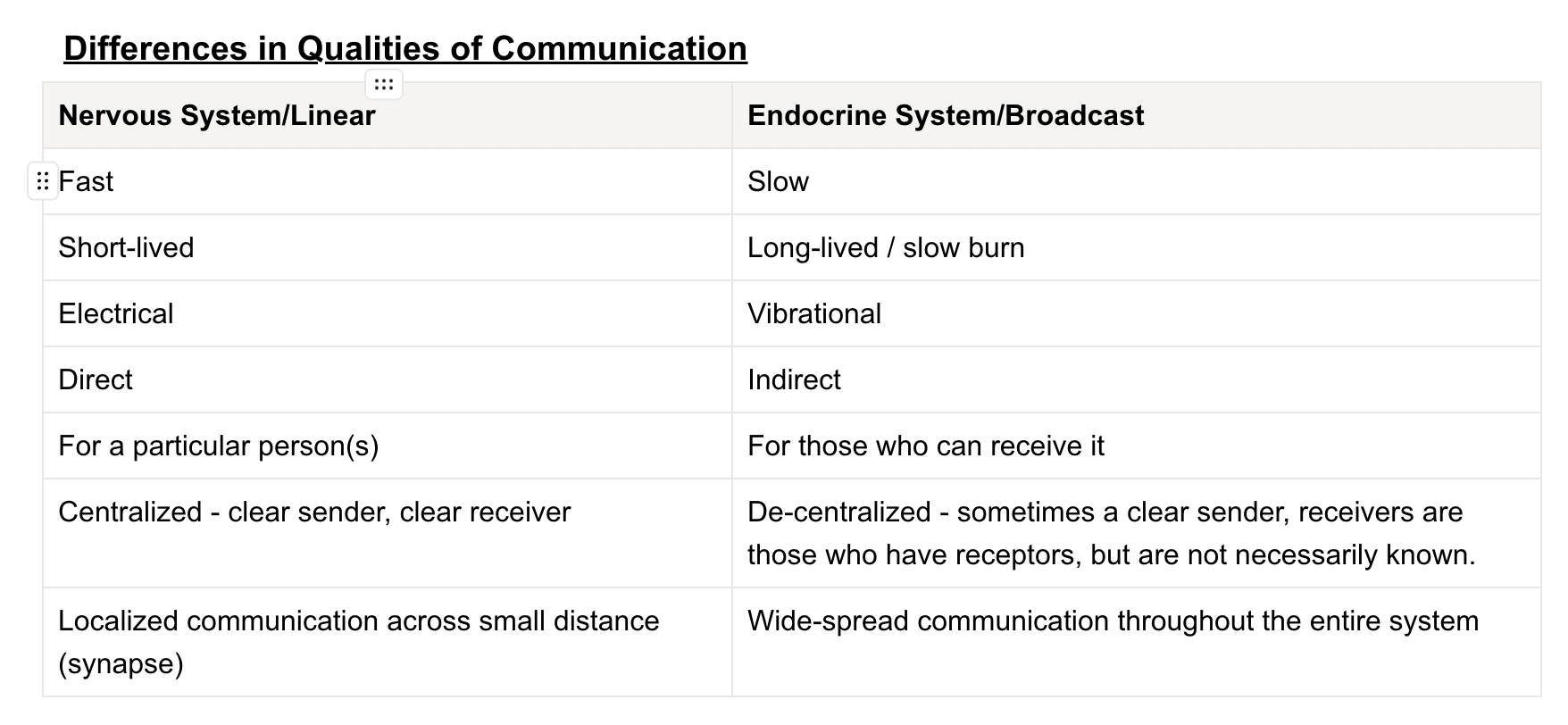
This difference already begins to nuance what we mean when we say “communication”. I offer below what I hope is a useful for discernment when giving and receiving messages, and I hope provides a sense of MORE choice when considering how to communicate within your organization.
Before you schedule your next meeting or send the next email, I invite you to ask yourself “Does my message need Nervous System or Endocrine System communication?”
Nervous System
For many, many millenia, people communicated directly with one another - conversations, letters, and then came phone calls, texts, direct messages. Apart from the occasional addresses to large crowds, most communication happened in an immediate and direct way. I have a message for someone, and I am contacting that person directly in person or via some object - a letter, a phone class, a text. That message is specific and created for them and no one else. This is like our nervous system. Comprised of neurons, one neuron fires and sends a signal to the next neuron. Like a baton passed during relay races, the signal races either to our brain (bringing along sensation information) or from our brain (sending motor/movement/response impulses).
When messages need to be sent multiple places - think about the organization our body requires to jump out of the way of a threat, or to play a sport - the same linear pathways apply much like an old-fashioned phone tree. For those born in the 90s or later, a phone tree would be activated when a message needed to reach many people. Before social media, phone trees would be set up where you would be responsible for calling three people, and each of those people was responsible for calling three people, etc. Parent-Teacher organizations, emergency response teams, even announcements of birth and death were communicated in this way. And even though this 'broadcasts' wide within a community, it is still this linear communication. One person calls one other person, one at a time.
Nervous system communication happens quickly, and its also short-lived. Its speed enables rapid adaptation to the moment, but requires significant repetition and practice in order to learn a pattern or habit. The same nerves must fire again and again and again in order for the pattern to stick.
The center of this communication is the brain and spinal cord. The communication medium is words/signals/electrical impulses.
Endocrine System
With the advent of broadcast (radios, tvs, social media), we created the ability to put a message out into the ether. Messages could travel by waves without a specific person as a destination. This is like our endocrine system of communication. We have several centers in our body that are constantly monitoring our internal state and working to deploy the right chemicals to match the current demands of the world around us. Our endocrine system is monitoring internally, to ensure we stay alive, and responding to external stimulation, to ensure we can act and engage with and in the world.
Our endocrine system makes chemicals called hormones, which are released into the bloodstream. Our cells that respond to these hormones have receptors that will 'pick up' these hormones if they are needed by the cells. Traditionally, anatomists have talked about the hormone and receptors like a key and a lock, respectively; i.e. that the hormone is a key that 'unlocks' the receptor to enable the hormone to enter the cell and affect the cellular process. What has been discussed more recently - in my BMC training and more recently by science - is that the connection is vibratory. The hormone vibrates at a certain frequency, and matches the receptor cell and this shared vibration opens up the cell to receiving . Instead of messages being “passed down”, they are communicated through resonance, like Ganying (感應) in ancient Chinese philosophy. From the I-Ching, “Things that accord in tone vibrate together. Things that have affinity in their inmost natures seek one another.”
Endocrine communication happens through broadcast, with the gland creating the hormone sending out the chemical message and only those cells with receptors for that hormone will receive it. The message is not for every cell. This is now our more common kind of communication - we broadcast our messages to thousands, millions, and trust that those that need the message will receive it - they will become our audience, our followers. There is an indirectness with endocrine communication, but there can also be a sense of relief - we just make the messages that are authentic, that we sense are needed in the moment - but we are not responsible for the delivery nor the receipt.
To get physiological, our endocrine system is comprised of glands, some of which I'm sure you've heard of: pituitary, pineal, thyroid, thymus, adrenals, pancreas, testes/ovaries, to name a few. They produce hormones you've heard of - cortisol, oxytocin, insulin. The endocrine glands produce hormones, and put them into the blood stream. For this reason, we find endocrine glands situated at highly-vascularized centers in our body; i.e. large artery intersections. Our body also has several 'way' stations, that measure our concentration of hormones in the blood, and then signal a hormonal response accordingly. These measuring stations work to ensure our body stays in homeostasis.
Endocrine system communication is de-centralized, indirect and slow. The message is only for those who have the ability to receive it, and the way it is communicated is through resonance/vibration. The effects are more longterm, and oriented towards homeostasis. While less immediate than nervous system communication, endocrine communication enables wide-spread communication across the whole system precipitating a unified, de-centralized response.
[Sidenote: endocrine disrupters. Endocrine disrupters are man-made chemicals that imitate closely enough hormones that they are received by your cell receptors, but they do not have what the cell is looking for - thus they 'clog' up the receptor, preventing your actual hormones to land, and additionally can expose your cells to toxins]
What is the ‘right’ way to communicate?
It depends on the message, who the recipient is, and the timing. My point here is that one-size does not fit all. We tend to have our own ‘communication’ style, but it might not be right for the moment or the message. You may need to lean in to what is uncomfortable for you personally, in order to best meet what the moment requires.
Stay tuned for Scenarios that make use of this framework!
© 2026 Empowered Learning by Design, Amanda Comstock
I analyze organizations through the lenses of somatic principles and ecological kinship. I honor our bodies and land as systems teachers and our sustainers of life.
My wish is to support restoration of right relationship with ourselves, with one another, with our ancestors and with the land, through what and how we practice at work.